

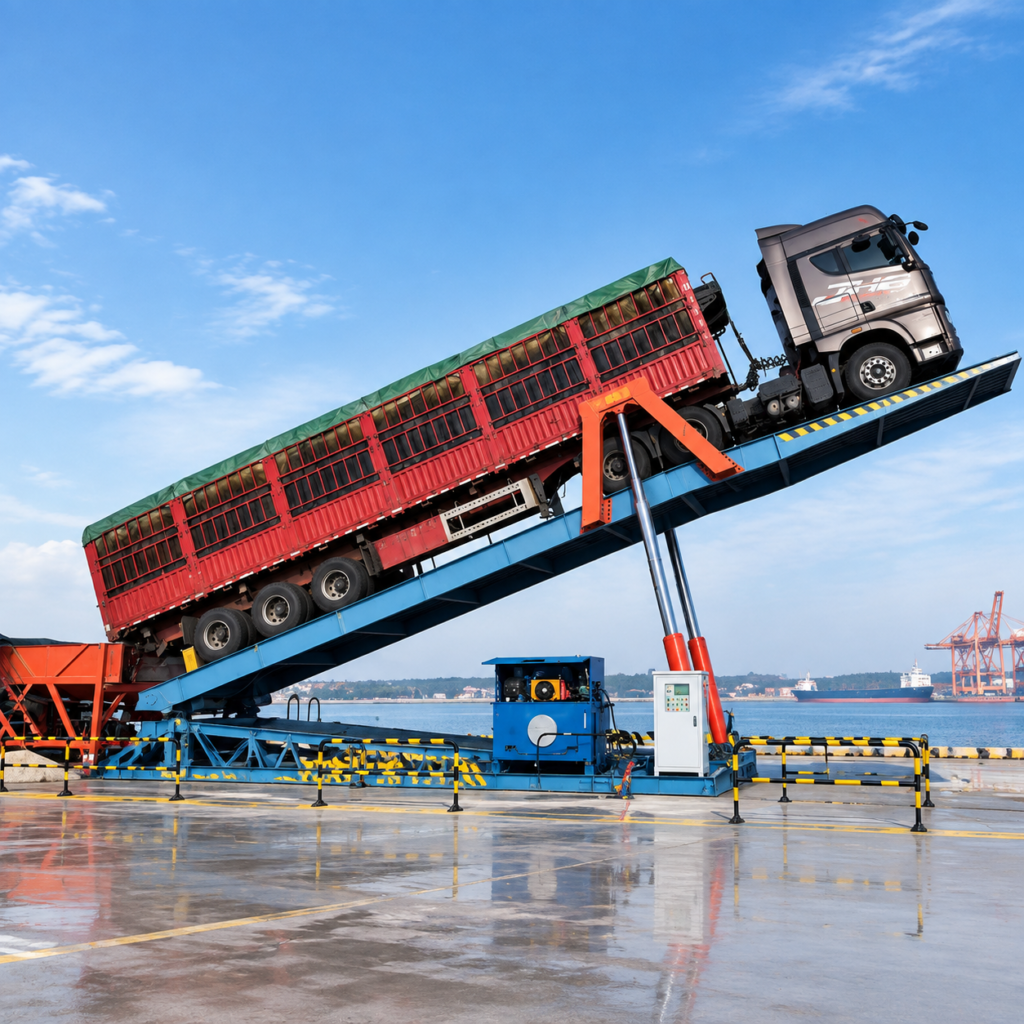
If your yard receives loose bulk material — grain, feed, coal, sand, fertiliser, wood chips or biomass — the unloading bay is almost certainly your slowest and most labour-intensive step. A typical 30–40 tonne truck is emptied by hand or with a small excavator in 60 to 120 minutes, and the work is dusty, dirty and hard on the crew.
A hydraulic turnover unloader solves the problem by rotating the vehicle itself. Instead of digging material out of the trailer, the machine clamps the truck, lifts it onto a tilting platform and lets gravity do the rest.
What happens during a turnover cycle
- Positioning. The truck reverses onto the platform and stops against the wheel stops. Most operators back in without a marshaller once the bay is marked out.
- Clamping. Hydraulic clamps lock the chassis and wheels so the vehicle cannot slide as the platform rises.
- Tipping. The platform rotates to a working angle of 45° to 70°, and the bulk material flows out through the tailgate into a receiving pit, hopper or conveyor.
- Return. The platform lowers, the clamps release and the empty truck drives away. A complete cycle is typically 6 to 12 minutes depending on load and angle.
Because nothing has to be shovelled or scooped, a single operator replaces a crew of three or four. That is where the widely quoted 60–80% reduction in unloading time comes from — the machine does not just work faster, it removes the manual handling step entirely.
Where turnover unloaders pay for themselves
- Grain and feed depots that receive dozens of trucks per day during harvest and cannot afford a queue at the pit.
- Fertiliser and chemical plants where dust control and enclosed discharge matter as much as speed.
- Ports and rail transhipment yards moving coal, ore, sand or biomass between road, rail and storage.
- Biomass power plants where the fuel arrives as loose chips and must be tipped reliably in all weather.
What to specify before you buy
The two machines that look identical in a photograph can be completely different in service. The specification questions that matter most are:
- Vehicle envelope. Overall length, width and height of the largest truck you will handle — not the average one. Long-wheelbase trailers need a longer platform and a different clamp geometry.
- Payload. Rated load should reflect the heaviest legal gross vehicle weight plus a safety margin, not the nominal truck capacity.
- Tipping angle. Free-flowing grain empties at a shallower angle than damp sand or sticky biomass. Tell the supplier exactly what you handle.
- Discharge side and receiving arrangement. Left, right or rear discharge, and whether the material falls into a pit, a hopper or onto a conveyor.
- Drive and power supply. Electric, diesel or electro-hydraulic, and the supply you actually have on site.
- Foundation and drainage. The machine transfers large eccentric loads into the floor. A designed concrete foundation and a wash-down path for the pit are not optional extras.
Safety features that matter
A turnover unloader lifts a fully loaded vehicle above head height, so the safety package deserves as much attention as the capacity rating. Look for hydraulic lock valves on every lifting cylinder, mechanical backstops that prevent roll-back, load and angle sensing with automatic stop, emergency stops reachable from the platform edge, and interlocked guard rails so the platform cannot be operated while someone is inside the tipping zone. Regular inspection of the hydraulic hoses, clamps and pivot pins should be part of the maintenance schedule, not a reaction to a failure.
The bottom line
If you are paying three people for two hours to empty each truck, a turnover unloader is usually one of the fastest-payback machines you can install in a bulks handling yard. The engineers who specify it well are the ones who bought for the heaviest vehicle and the most difficult material they ever expect to see — not the easiest day of the year.
Need a recommendation for your site? Send us your truck type, load weight, lifting height or duty cycle and our engineers will come back with a sizing recommendation and quotation — usually within one working day. Request a quote.