

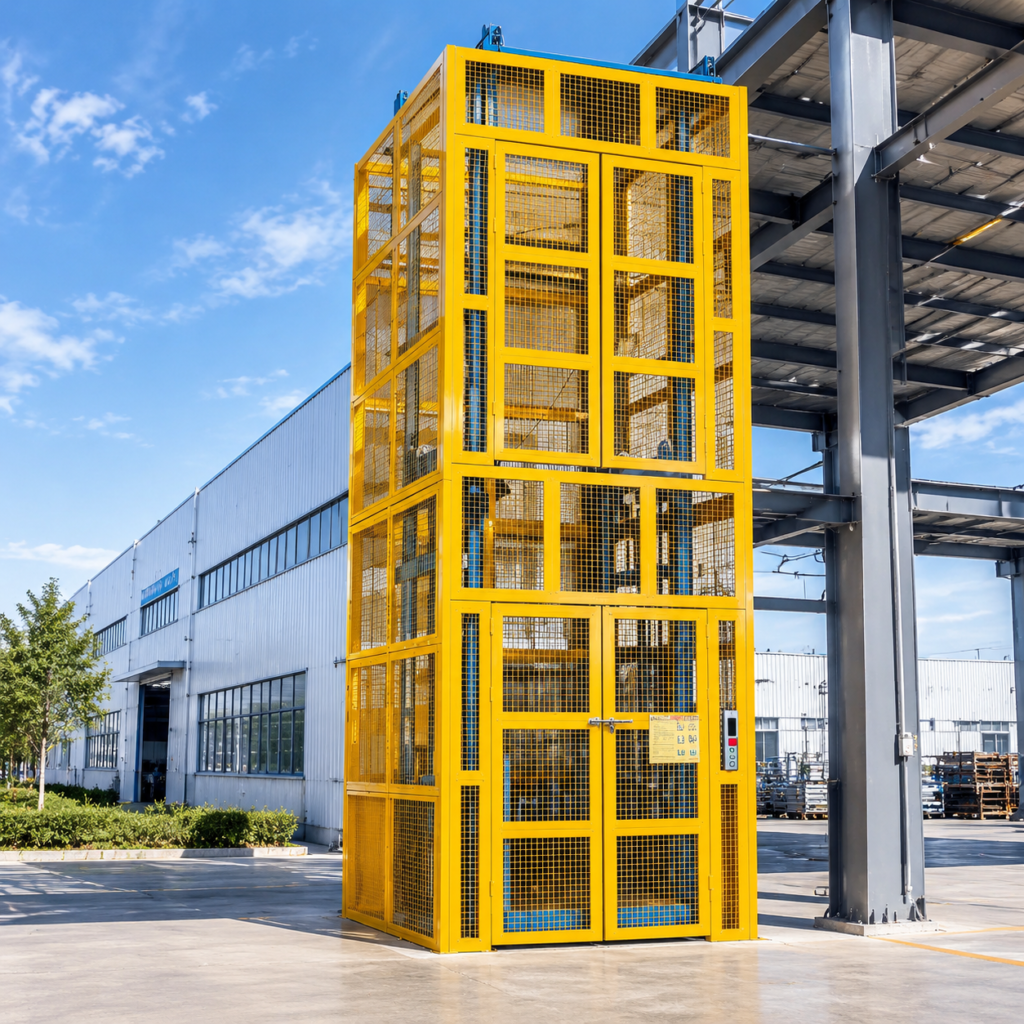
Vertical movement inside a warehouse or factory is where most material handling layouts break down. A forklift works beautifully on one level and stops dead at the edge of a mezzanine. A passenger-style freight elevator is expensive, slow to cycle and awkward to integrate with a production flow. Between the two sits the guide rail hydraulic lift platform — a simple, robust machine that raises goods, pallets or even a small vehicle between levels on a closed hydraulic circuit.
How a guide rail lift works
A steel platform runs between two or four vertical guide rails. A hydraulic cylinder lifts the platform directly or through a chain-and-pulley multiplying system, so a relatively short stroke produces a long travel height. Because the platform is held by the rails rather than by a mast, the machine has a very small footprint and can be installed indoors against a wall, outdoors in a yard, or through a floor opening.
Typical capacities and travels
- Standard models from 0.3 to 20 tonnes rated load, with custom designs above that.
- Travel heights from one floor to over 12 metres, with multi-stop control for three or four levels.
- Platform sizes from a single pallet footprint up to a car-sized deck, with through-loading or C-shaped configuration.
Why not just use a ramp or a freight elevator?
- Footprint. A ramp that a counterbalance forklift can climb needs a long, shallow slope — space that most buildings simply do not have. A guide rail lift needs a few square metres.
- Cost and lead time. A lift platform is a fraction of the cost of a certified freight elevator and does not require the same shaft construction.
- Outdoor capability. With the right finish and an electro-hydraulic power pack, guide rail lifts work in yards, loading courts and cold storage vestibules where an elevator would never be installed.
- Integration. Roller conveyor decks, powered gates, and interface signals to a sorting line are all straightforward to add at build time.
The specification questions that decide the design
- Rated load and point loading. A pallet of dense material concentrates load in a small area. Say what the heaviest single item looks like, not just the total weight.
- Travel height and number of stops. Tells the supplier whether a direct-acting cylinder or a chain-multiplied system is required.
- Platform size and entry direction. Opposite-side (through) or same-side (C) entry changes the structure and the guarding.
- Type of goods. Pallets, drums, carts, pallet trucks or vehicles — each needs a different deck surface and ramp arrangement.
- Environment. Indoor, outdoor, dusty or wash-down duty drive the finish, IP rating of the control box and choice of hydraulic oil.
- Safety guarding. Gates, interlocked enclosures, light curtains and safety edges should be selected against the actual risk, not fitted as an afterthought.
Installation and upkeep
Most guide rail lifts are delivered as a unit and installed by anchoring the rail posts to a designed concrete base and wiring the power pack. Because the hydraulic circuit and the rails carry the load, there is no need for a structural shaft — but the floor beneath the machine must be engineered for the concentrated load, and drainage should be planned if the lift sits outdoors. Day-to-day maintenance is limited to checking oil level, inspecting hoses and pivot pins, and keeping the guide rails clear of debris.
Choosing well
The right guide rail lift is designed around the load you handle most often, with a margin for the heaviest item you might ever receive. Get that wrong in either direction and you either pay for capacity you never use, or you are forced to turn work away. Bring your floor plan, your load data and your cycle requirements to the conversation early — it is much cheaper than retrofitting.
Need a recommendation for your site? Send us your truck type, load weight, lifting height or duty cycle and our engineers will come back with a sizing recommendation and quotation — usually within one working day. Request a quote.