

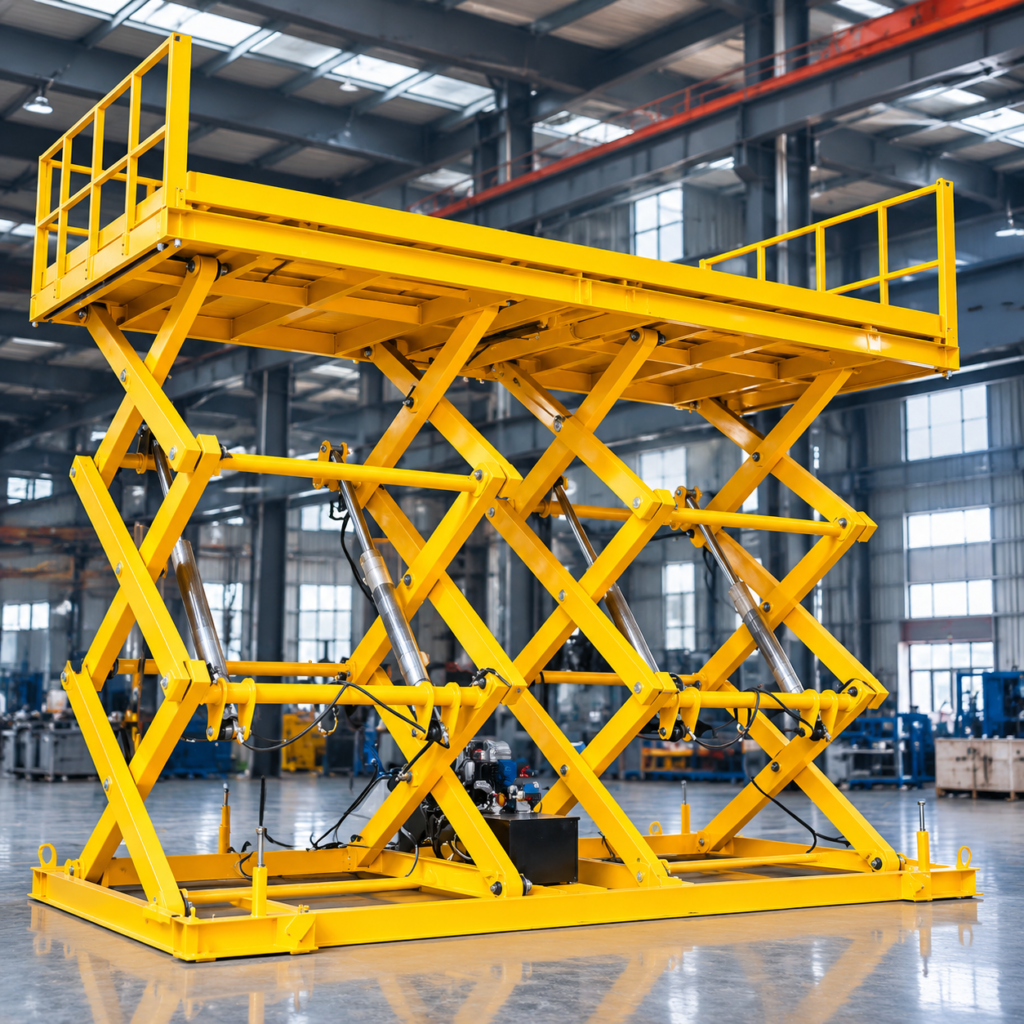
Almost every project that starts with the words "we need a lifting platform" hits the same fork in the road: a fixed installation or a mobile one. The answer is rarely a matter of preference — it follows from how often the platform moves, what it is lifting and where it has to work.
What each machine is actually good at
Fixed (stationary) scissor lift platforms
- Mounted flush to the floor or in a shallow pit, so pallet trucks and forklifts roll straight on and off with no obstruction.
- Built for high cycle counts: hundreds of lifts per shift is normal duty, not an exception.
- Available in through-loading or C-configuration, with roller conveyor decks, turntables and powered gates.
- Loaded with capacities from a few hundred kilograms up to tens of tonnes, with heavy-duty models engineered for two-shift operation.
Mobile scissor lift platforms
- Self-propelled or towed, with wheels and deployable outriggers for stability once in position.
- Perfect where the work moves: servicing overhead lines, working inside a large shed, loading at several doors, or maintaining equipment in the yard.
- Electric or battery drive for indoor use, with non-marking tyres and quiet operation.
- Deployable outriggers and levelling make them usable on imperfect surfaces — a big advantage on existing sites.
Side-by-side comparison
- Primary duty. Fixed: moving product between levels all day. Mobile: moving the work platform to the job.
- Footprint in operation. Fixed: permanently occupies its bay. Mobile: occupies only during the task.
- Throughput. Fixed platforms cycle far faster — hydraulic power is sized for continuous use and there is no setup time.
- Installation. Fixed needs a foundation and a pit or ramp arrangement; mobile needs only a firm, level surface.
- Cost profile. Fixed is a capital project with civil work; mobile is a mobile asset with lower installation cost.
- Safety system. Both need guard rails, safety edges and interlocks; fixed installations usually add gates or light curtains where people can enter the platform zone.
A short decision checklist
- Does the load move to the platform, or the platform to the load?
- How many cycles per hour must it handle, and for how long each day?
- Is a flush, obstruction-free deck required for pallet trucks or forklifts?
- Is there space and budget for civil work, or does the machine have to be dropped onto an existing floor?
- Will the work be indoors in a clean area, or outdoors in dust and weather?
Hybrid cases
Two situations blur the line. The first is a multi-stop fixed lift serving three or four levels, which behaves like a small freight elevator but costs far less, and is usually the better answer than several mobile units in a fixed production flow. The second is a mobile unit used as a dock lift — perfectly workable for occasional loading, but the wrong choice if it is raised and lowered dozens of times a day.
Getting it right
Whichever route you take, size the platform for the heaviest pallet or vehicle it will ever see, check that the deck surface and entry arrangement suit your equipment, and make sure the safety guarding reflects how people actually behave around the machine. A five-minute conversation about duty cycle and load data at the quotation stage prevents almost every wrong purchase we see.
Need a recommendation for your site? Send us your truck type, load weight, lifting height or duty cycle and our engineers will come back with a sizing recommendation and quotation — usually within one working day. Request a quote.