

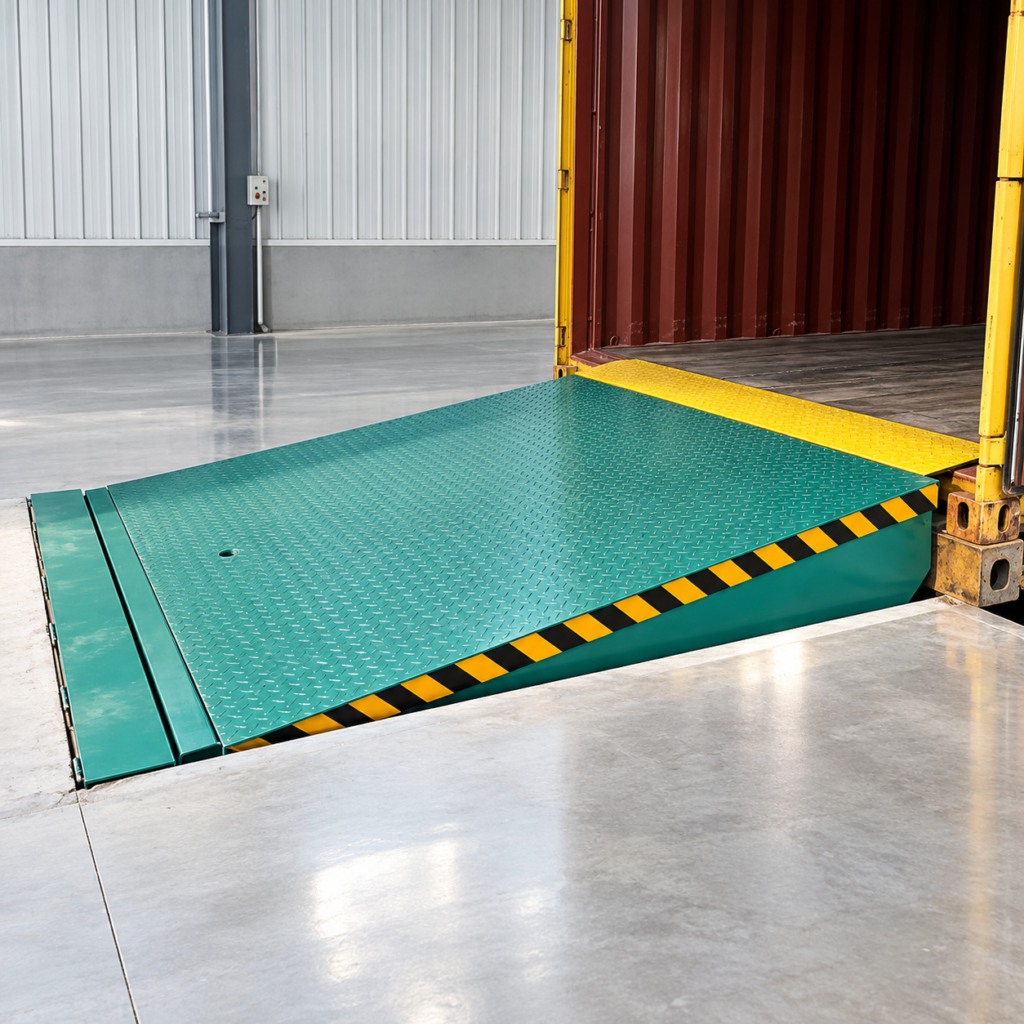
Every trailer that arrives at your dock brings the same two problems: the trailer deck rarely sits at the same height as your warehouse floor, and the gap between them is exactly where forklifts, pallet trucks and people are moving fastest. A dock leveler and, where there is no dock at all, a mobile boarding bridge exist to close that gap safely and consistently.
Dock levelers: closing the height difference
A dock leveler is a hinged steel platform installed at the edge of the dock, with a lip that extends onto the trailer bed. It absorbs the difference between the dock height and the trailer deck, which varies with trailer type, tyre pressure, load and suspension. Two families dominate:
- Mechanical levelers are driven by spring and counterbalance. They are simple, need no power and suit low-cycle bays.
- Hydraulic levelers are push-button operated, allow fast positioning and are the normal choice for busy, high-cycle docks — including models that also raise the lip to service trailers parked below dock height.
Capacity typically ranges from 6 to 12 tonnes, sized not for the load but for the dynamic force of a laden forklift crossing the lip at an angle. That is the number worth arguing about with your supplier, because it determines the platform thickness, the hinge design and the lip strength.
Boarding bridges: when there is no dock
Not every site has a raised loading dock. In yards, factories, farms, markets and construction sites, the truck is loaded at ground level and a forklift has to climb into it. A mobile boarding bridge is a self-contained ramp with a hydraulic height adjustment, side rails and an anti-slip deck. Set the lip on the trailer, lock it, and a counterbalance forklift or pallet truck drives in and out safely.
- Suitable for trailer beds up to around 1.8 m above ground, with adjustable lip height.
- Available with pneumatic or solid tyres so it can be towed between bays, or mounted permanently on a frame.
- Side guards and a running-surface profile chosen for the equipment that will cross it.
- Optional powered lip and levelling for one-person operation.
The safety practice that matters more than the hardware
The machine does not keep anyone safe by itself — a consistent routine does:
- Restrain the vehicle. Wheel chocks or a proper vehicle restraint system must be in place before the lip is set. Trailer creep and pull-away are the classic fatal accidents.
- Control access. Nobody under or behind the platform while it moves; gates or barriers where pedestrians could walk into the bay.
- Keep it level and supported. Check that the lip is fully seated on the trailer bed and that the trailer deck can carry the crossing load.
- Light it properly. Dock lighting and trailer-interior lighting should be bright enough to see the fork tips at the deepest point.
- Inspect weekly. Hinges, lip pivots, hydraulic hoses, springs and welds are all wear points, and all cheap to fix before they fail.
- Train and repeat. Most incidents are caused by an experienced operator taking a shortcut on a busy day. Short refresher training pays for itself.
Choosing between the two
If the building was designed with a raised dock, a hydraulic dock leveler is the standard solution and the investment is easy to justify on throughput alone. If the truck parks on the ground, or if you load at customer sites, a mobile boarding bridge is the practical answer. Sites that do both will usually have a leveler on the main bay and a bridge kept free for the yard.
Need a recommendation for your site? Send us your truck type, load weight, lifting height or duty cycle and our engineers will come back with a sizing recommendation and quotation — usually within one working day. Request a quote.