

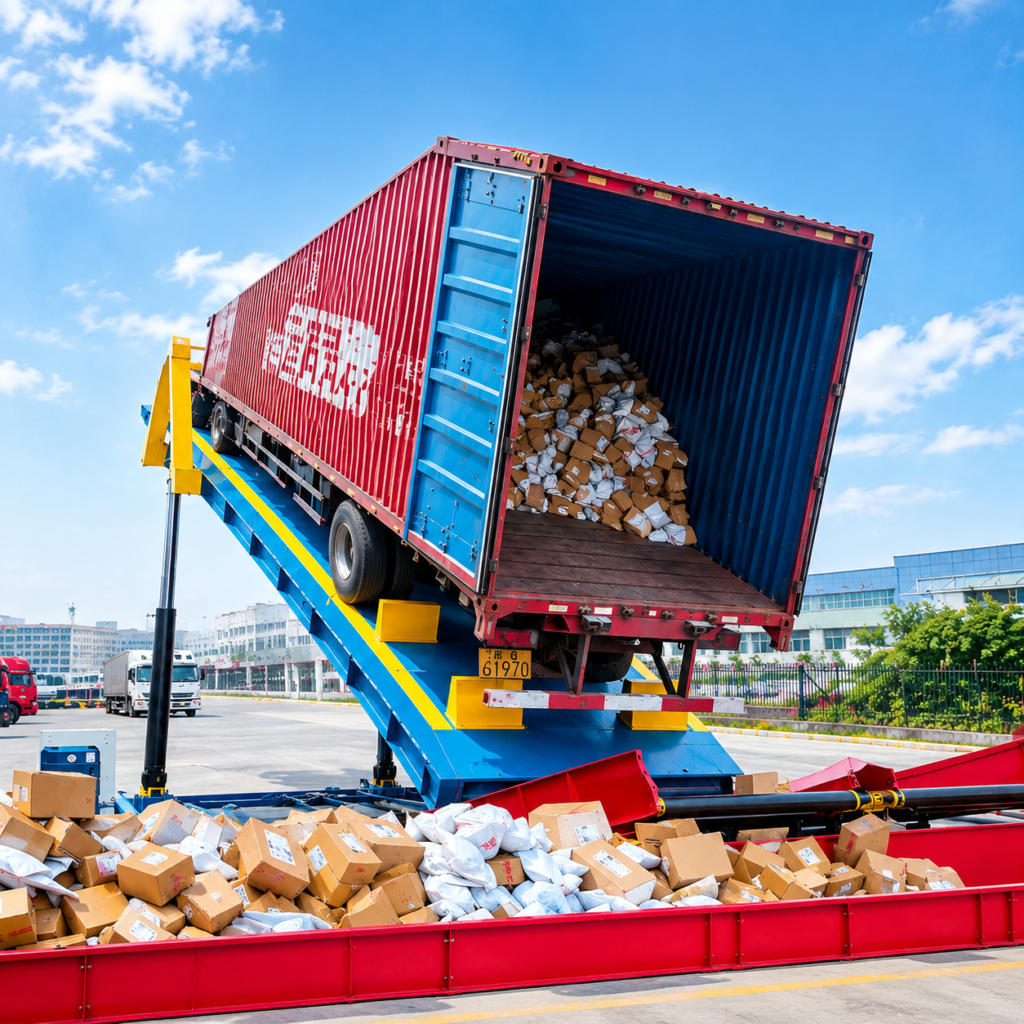
For couriers, e-commerce 3PLs and distribution centres, the parcel unloading bay is a stress test with a predictable outcome: the volume doubles or triples during promotions, the labour pool is exactly the same size, and the backlog forms inside the trailer. Every minute saved per vehicle compounds across hundreds of vehicles a week.
Why manual unloading fails at peak
- A 40-foot trailer of loose parcels typically needs two to four staff and 60 to 120 minutes to clear by hand.
- The work is the most physically damaging in the building — repeated lifting from the trailer floor, in awkward positions, often in poor light.
- At peak, staff shortages mean the same crew is pushed harder, which is precisely when injury risk and error rates climb.
- Manually carried parcels also bypass scanning at the trailer, so visibility and sortation accuracy suffer before the parcels even reach the sorter.
The equipment that removes the bottleneck
Extendable boom conveyors
A belt conveyor with a telescopic boom is driven into the trailer. Operators work close to the load instead of carrying parcels to the door, so walking distance — typically the largest single component of unloading time — disappears. Belt reversing, adjustable height and steerable end sections let the crew start at the nose of the trailer and work outwards.
Multi-stage parcel unloaders
Where parcels arrive loose, in bags or in mixed sizes, a multi-stage unloader combines a receiving belt, a hydraulic lift and a discharge conveyor. The platform height matches the trailer floor, the belt takes the parcels away, and the operator never lifts above waist height. These systems pair well with inline scanning and automated sortation.
Hydraulic dock lifts and scissor tables
For heavy or palletised express freight, a scissor or dock lift brings the working surface to the operator instead of the other way around. Combined with roller decks they also serve as transfer points between the dock and the sortation line.
Sizing the system
- Throughput. Work from the peak hour, not the daily average. Ask the supplier for pieces per hour at a stated parcel size mix.
- Package profile. Weight range, carton sizes, bags, soft packs and the share of odd shapes all affect belt width and gate design.
- Trailer fleet. Standard 40-foot vans need a longer boom than a mixed fleet of rigid trucks.
- Dock geometry. Dock height, door width, available depth inside the building and where the parcels have to go next.
- Integration. Scanning position, sortation induction, and whether the system needs to feed a sorter or a staging area.
- Power and controls. Simple local controls versus integration with your WMS and sortation PLC.
What the payback usually looks like
Extendable conveyors and parcel unloaders are typically justified on three lines at once: labour hours removed from the bay, fewer vehicles waiting outside the gate, and a measurable drop in manual handling injuries. Because unloading time falls from 60–90 minutes towards 15–30 minutes per trailer, the improvement is visible in the first week and compounds every peak season after that.
Plan it before the next peak
Conveyor-based unloading is not something to commission in November. Measure your actual unloading times for a week, record peak volumes and parcel profiles, and design the system around the number that the building has to survive — not the comfortable average. That is the specification that keeps the dock flowing when it matters most.
Need a recommendation for your site? Send us your truck type, load weight, lifting height or duty cycle and our engineers will come back with a sizing recommendation and quotation — usually within one working day. Request a quote.